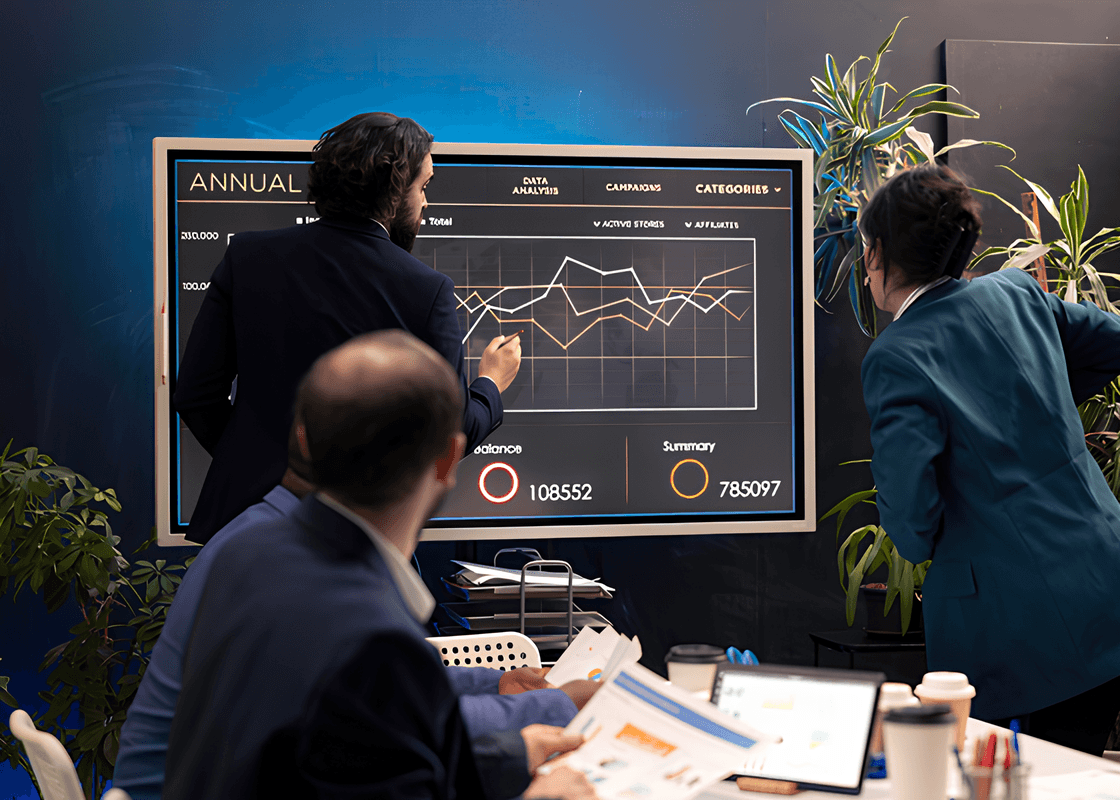
How time series and forecasting help you make smarter business decisions
In a world where business environments shift quickly and decisions need to be fast, informed, and data-driven, organisations can no longer rely on intuition alone. They need clarity on what’s likely to happen next — whether it’s demand fluctuations, cost movements, operational load, or customer behaviour. This is where time series analysis and forecasting step in. By studying past trends and patterns, forecasting helps businesses anticipate outcomes, prepare in advance, and act with greater confidence.
What is time series and forecasting?
Time series refers to data collected over consistent time intervals — daily sales, monthly revenue, weekly production volumes, customer visits, inventory usage, expense patterns, and more. When this time-based data is analysed, it reveals trends, recurring cycles, seasonal variations, and deviations that shape business performance.
Forecasting uses these insights to estimate what may happen in the future. With statistical models and machine learning techniques, organisations can predict demand, revenue, costs, operational pressure, risks, and behavioural patterns with remarkable accuracy. Instead of reacting when change occurs, leaders get visibility into what’s coming and can plan ahead.
Converts historical data into decision intelligence
Every business collects data over time, but forecasting turns that history into future clarity. Leaders can understand whether demand will rise or drop, which months are cost-heavy, where capacity pressures might occur, and how customer behaviour evolves at different points in the year. This visibility helps shape pricing, budgeting, procurement, staffing, production, and investment planning with far more confidence.
Improves demand and inventory planning
One of the most practical uses of time series forecasting is predicting demand. When organisations can see seasonal peaks, consumption patterns, and cyclical volume changes, they can manage inventory more accurately and avoid both shortages and over-stocking. Procurement teams can time purchases better, operations can prepare capacity in advance, and businesses can respond faster to market shifts.
Strengthens financial planning
Budgeting and financial strategy depend heavily on understanding revenue cycles, expense fluctuations, and projected growth. Forecasting models help estimate future financial performance by analysing historical billing cycles, cost rhythms, receivables, or market dynamics. This supports more precise budget allocation, fund planning, investment decisions, and working capital management.
Enhances operational efficiency
Operations are most efficient when capacity is sized to meet expected demand. Forecasting helps organisations anticipate the load on facilities, production lines, service centres, logistics networks, energy needs, and workforce schedules. When resources are aligned with predicted utilisation, organisations reduce wastage, prevent bottlenecks, and improve service quality.
Gives visibility into customer behaviour
Time series insights also reveal how customers think, engage, and buy. Businesses can spot repeat purchase cycles, renewal patterns, usage frequency, or drop-off periods — which helps shape marketing strategy, product timing, campaign planning, and loyalty engagement. Instead of guessing what customers will want, organisations act on behavioural trends already proven by their data.
Identifies abnormalities and risk
Forecasting doesn’t just show patterns — it highlights when behaviour shifts unexpectedly. Sudden spikes, unusual cost jumps, traffic drops, or irregular performance signals are easier to detect, helping teams respond before issues escalate. These early warnings strengthen compliance, operational resilience, and risk management practices.
How to implement forecasting effectively
Strong forecasting depends on clean data, clear outcomes, and suitable models. Organisations need to define what they want to predict — demand, cost, revenue, capacity, or behaviour — then gather reliable time-stamped data from operational, financial, and customer systems. Once historical records are structured, models such as ARIMA, exponential smoothing, regressions, or even ML-based forecasting engines can be applied. Continuous validation against actual outcomes helps refine predictions and improve accuracy over time.
The key is to make forecasting an ongoing practice rather than a one-time analysis. When predictions consistently inform decisions, businesses become proactive instead of reactive.
Conclusion
Time series and forecasting transform historical data into strategic foresight. By understanding trends, seasonal cycles, operational rhythms, and behavioural shifts, organisations gain sharper judgement and make decisions rooted in evidence. Whether it’s planning capacity, managing inventory, shaping financial targets, or strengthening customer strategy, forecasting empowers leaders to operate with clarity and confidence. In an unpredictable business world, foresight isn’t just a competitive advantage — it’s becoming essential.
