
Choosing the right IT company is one of the most important decisions a business can make. Whether you are a startup, SME, or established enterprise, your technology partner plays a crucial role in keeping your operations secure, efficient, and ready for growth.
Beyond resolving technical issues, the right IT provider should help improve productivity, strengthen cybersecurity, manage cloud and IT infrastructure, support business continuity, and align technology with your long-term business goals.
Dubai has developed into one of the region's leading business and technology hubs, with companies increasingly relying on cloud platforms, connected systems, cybersecurity solutions, business applications, and digital infrastructure. This creates a wide range of options when choosing an IT provider, but it also makes the selection process more complex.
Businesses should look beyond pricing and evaluate an IT company based on its technical expertise, UAE market experience, responsiveness, security practices, service commitments, and ability to support future growth.
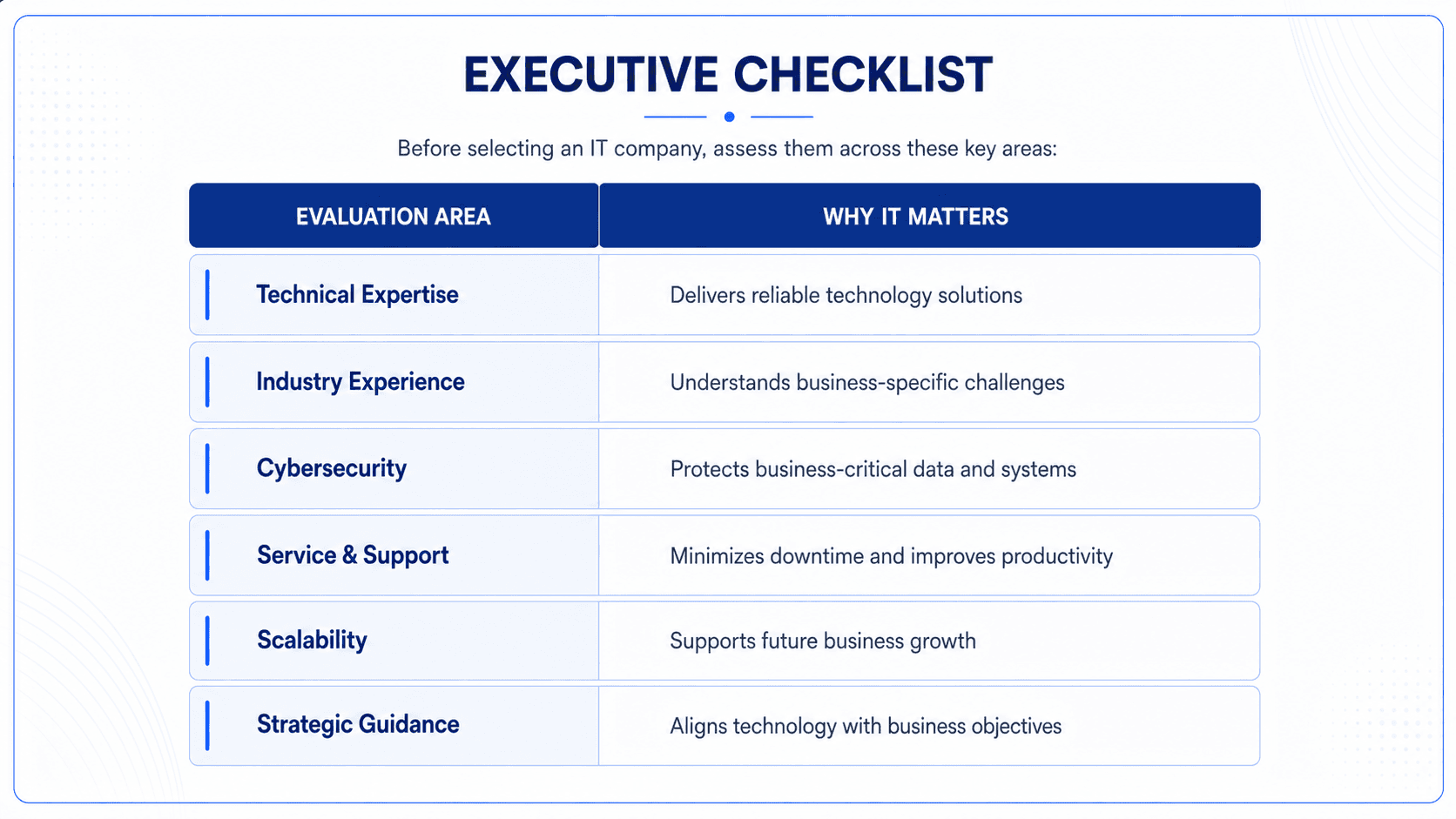
1. Do They Understand Your Business Requirements?
Every organization has different operational goals, technology requirements, and security needs. Some businesses may require comprehensive managed IT services, while others may prioritize cloud migration, cybersecurity, networking, ERP systems, or digital transformation.
A good IT partner should understand your existing infrastructure, business processes, workforce, locations, applications, and growth plans before recommending a solution.
For businesses operating in Dubai, the provider should also understand the practical requirements of supporting local offices, distributed teams, cloud environments, and business-critical systems.
Their recommendations should be aligned with your objectives, budget, operational requirements, and future plans rather than being based on generic service packages.
2. Do They Have Relevant Industry Experience?
Different industries face different technology, security, and compliance requirements.
Healthcare organizations handle sensitive information, financial businesses require strong security and availability, retailers depend on reliable point-of-sale and customer systems, while logistics and real estate businesses may rely heavily on cloud applications and connected platforms.
Ask whether the IT company has experience supporting organizations similar to yours and whether it understands the operational requirements of your industry in the UAE.
Relevant experience can lead to smoother implementation, faster troubleshooting, better security practices, and technology solutions that are more closely aligned with your business processes.
3. Are Their Technical Capabilities Up to Date?
Technology changes rapidly, so an IT provider should continuously update its technical knowledge and capabilities.
Look for providers with relevant certifications, vendor partnerships, experienced technical teams, and expertise across areas such as:
Cloud infrastructure
Networking
Cybersecurity
Microsoft and other business platforms
Backup and recovery
Endpoint management
Infrastructure monitoring
Business applications
IT automation
For Dubai-based businesses, the provider should also be capable of supporting modern hybrid and cloud-first environments while maintaining appropriate security and availability.
An experienced technical team can help you adopt new technologies without compromising reliability or security.
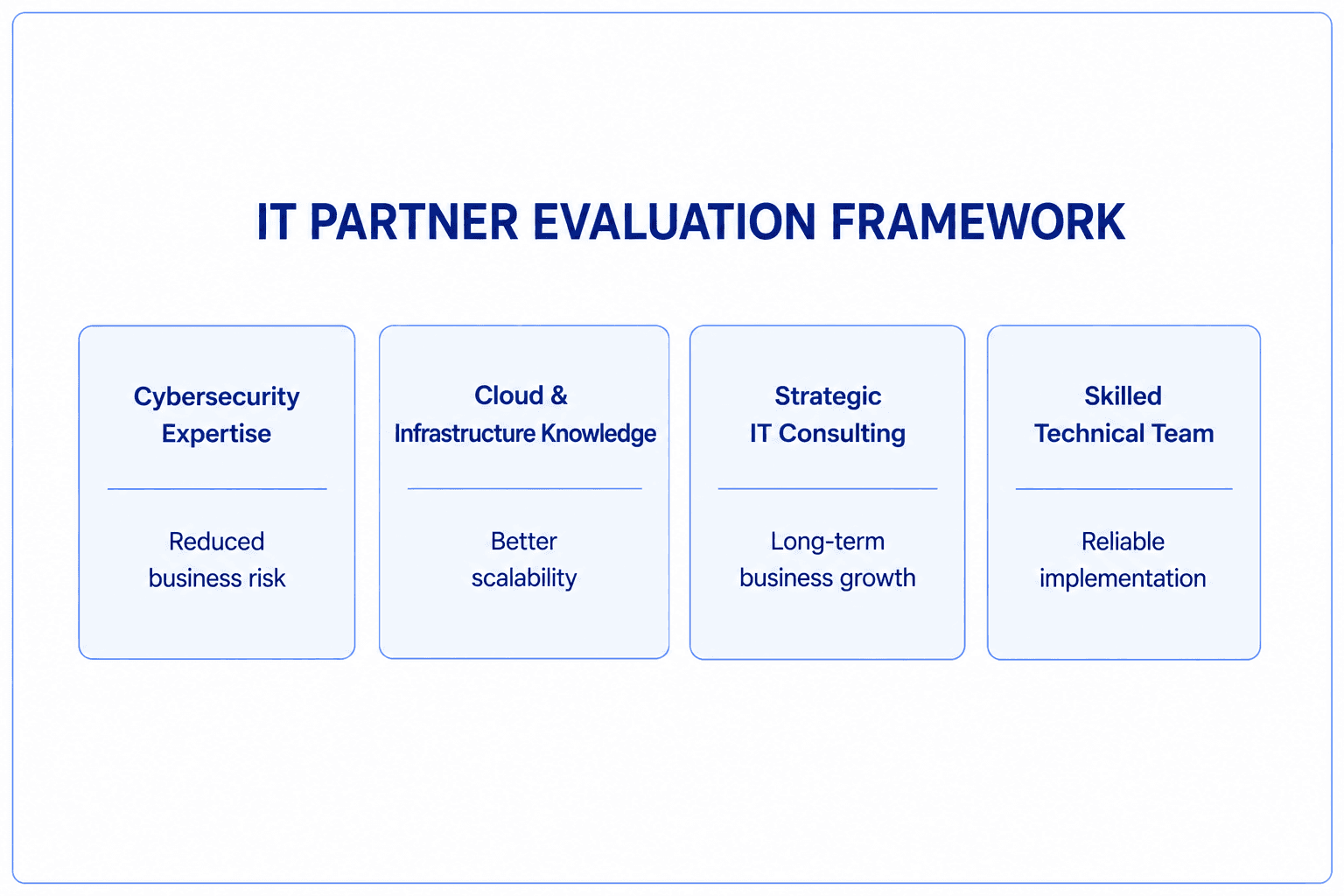
4. Can They Demonstrate Proven Success?
A reputable IT company should be able to provide client testimonials, case studies, or examples of successful projects.
Ask how they handled challenges similar to yours and what measurable improvements they delivered. For example, did they reduce downtime, improve infrastructure performance, strengthen cybersecurity, migrate systems to the cloud, or improve employee productivity?
You can also ask about their experience supporting businesses with multiple locations or employees working across different environments.
Long-term client relationships and measurable project outcomes can provide valuable insight into service quality and reliability.
5. What Is Their Approach to Cybersecurity?
Cybersecurity should be a core consideration when selecting an IT provider.
Businesses in the UAE face risks such as phishing, ransomware, unauthorized access, data loss, and other cyber threats. Your IT partner should therefore take a proactive approach to protecting business systems and information.
Key areas to discuss include:
Endpoint protection
Firewall management
Multi-factor authentication
Email security
Security monitoring
Vulnerability management
Patch management
Data backup
Disaster recovery
Incident response
Employee security awareness
Also ask how the provider approaches data protection and whether its processes support applicable UAE data protection requirements, including the UAE Personal Data Protection Law and any sector-specific or free-zone requirements relevant to your organization.
Strong cybersecurity practices can reduce operational risk while improving business resilience.
6. How Responsive Is Their Support?
IT problems can quickly affect productivity, customer service, and revenue. A provider's support model should therefore be clearly defined before you sign a contract.
Ask about:
Support hours
Response and resolution targets
Service Level Agreements (SLAs)
Escalation procedures
Helpdesk availability
Remote support
On-site support
Emergency support
After-hours assistance
For businesses operating in Dubai, it is particularly important to understand whether the provider can respond to critical incidents affecting your physical office, network, servers, or other on-site infrastructure.
Clear service commitments provide greater confidence that issues will be handled appropriately when they occur.
7. Can Their Solutions Scale as Your Business Grows?
Your IT infrastructure should support business growth rather than become a limitation.
Consider whether the provider can support you when you:
Add employees
Open new offices
Expand into other UAE locations
Move more workloads to the cloud
Introduce new business applications
Support hybrid or remote employees
Increase cybersecurity requirements
A scalable IT strategy can reduce the need for expensive infrastructure changes and help your organization grow with fewer technology disruptions.
8. Is Their Pricing Transparent?
Price is important, but the lowest-cost provider may not deliver the best value.
Ask for a clear breakdown of all costs, including:
IT support and maintenance
Implementation fees
Hardware
Software licensing
Cloud subscriptions
Cybersecurity services
Backup and recovery
On-site support
After-hours or emergency support
Additional service charges
Businesses in Dubai should also clarify whether pricing is based on the number of users, devices, locations, support hours, or specific services.
Transparent pricing makes it easier to compare providers and reduces the risk of unexpected costs after signing the contract.
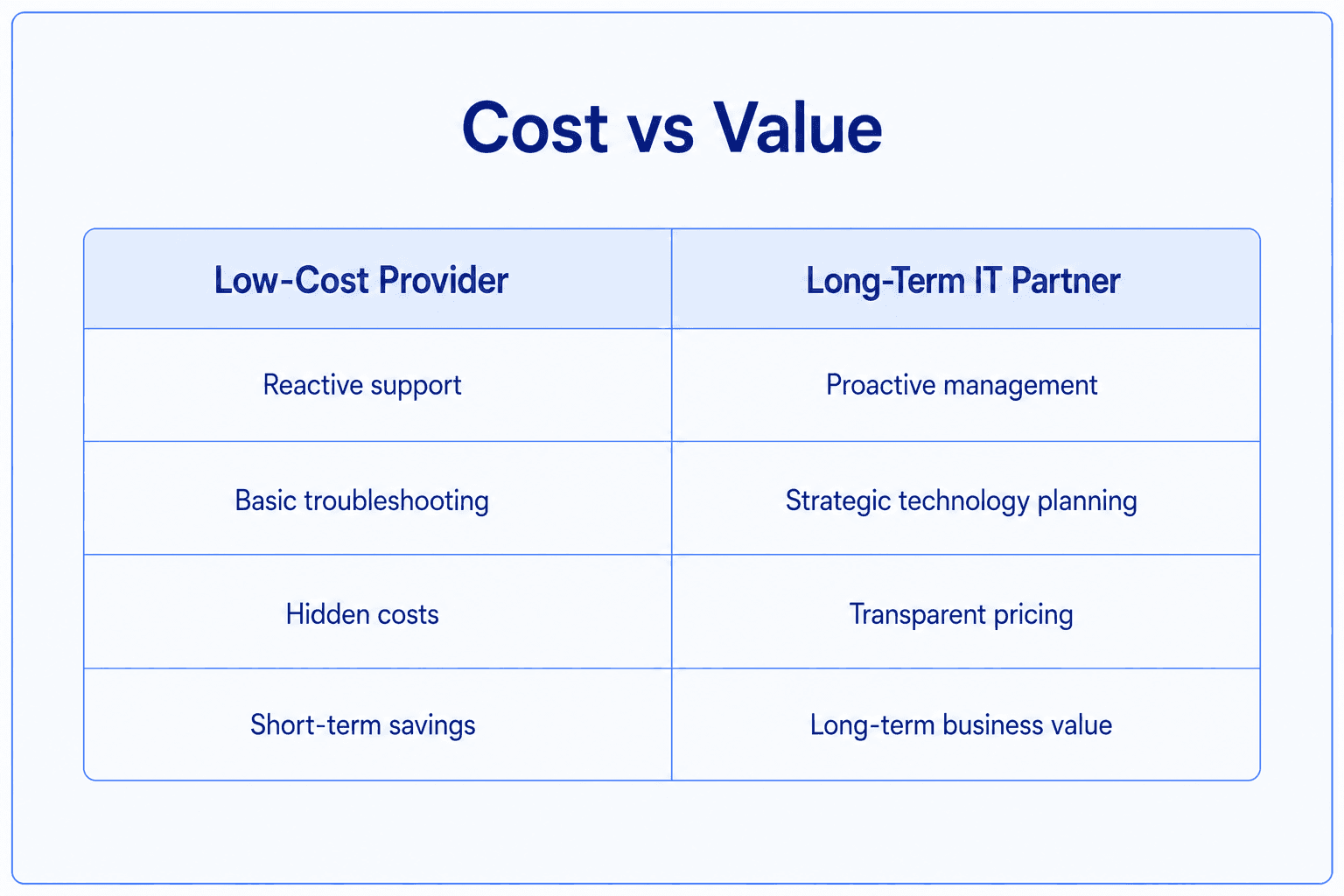
9. Do They Take a Proactive Approach?
The best IT providers do more than respond when something breaks. They actively monitor systems and identify potential problems before they cause major disruption.
Ask whether the provider offers:
24/7 monitoring
Preventive maintenance
Patch management
Security monitoring
Backup monitoring
Performance optimization
Regular infrastructure reviews
Technology recommendations
A proactive approach can reduce downtime, improve system reliability, and help identify security or infrastructure issues before they become serious problems.
10. Will They Be a Strategic Technology Partner?
Technology should contribute to business growth rather than simply support day-to-day operations.
A capable IT provider should be able to advise your business on areas such as:
Cloud adoption
Infrastructure modernization
Cybersecurity
Data management
Business applications
Automation
Disaster recovery
Technology planning
The right provider should understand where your business is heading and help ensure that your technology investments continue to deliver value as your organization evolves.
11. Do They Provide On-Site IT Support in Dubai?
Remote support can resolve many technical issues, but some problems require an engineer to be physically present.
Before hiring an IT company, ask whether they provide on-site support in Dubai and what areas their engineers cover.
Clarify:
Whether on-site visits are included in the contract
Expected arrival times for critical incidents
Whether emergency visits are available
Which Dubai locations they support
Whether there are additional call-out charges
Whether they maintain local technical resources
For businesses that depend on office networks, servers, Wi-Fi, access systems, printers, or other physical infrastructure, reliable local support can be an important part of minimizing downtime.
12. What Does the IT Support Contract Include?
Do not assume that every service is included in a managed IT support contract.
Ask the provider to clearly explain what your agreement covers. This may include helpdesk support, monitoring, cybersecurity, software updates, backups, cloud management, network maintenance, hardware support, and on-site assistance.
You should also understand what is excluded and whether additional charges apply for emergency support, new installations, hardware replacements, third-party applications, or work outside normal service hours.
A clearly defined contract helps avoid misunderstandings and makes it easier to measure the provider's performance.
13. What Are Their SLA Commitments?
A Service Level Agreement should clearly define what you can expect from your IT provider.
Ask for specific commitments covering:
Initial response time
Resolution targets
Critical incident handling
Escalation procedures
Support availability
Communication during major incidents
Service reporting
Performance reviews
For business-critical systems, ask how the provider classifies incidents and what response is expected for a complete outage or major cybersecurity event.
Avoid vague promises such as "fast support." A strong SLA should provide measurable service commitments that can be reviewed throughout the relationship.
Red Flags to Watch For
Be cautious if an IT provider:
Focuses only on price rather than business value
Cannot explain its support process clearly
Offers unclear pricing
Has limited cybersecurity expertise
Cannot provide relevant client references
Relies entirely on reactive support
Does not provide clear SLA commitments
Has no practical disaster recovery strategy
Cannot provide reliable on-site support when required
Does not clearly explain data protection responsibilities
Has limited experience with cloud infrastructure
Cannot explain how backups are monitored and tested
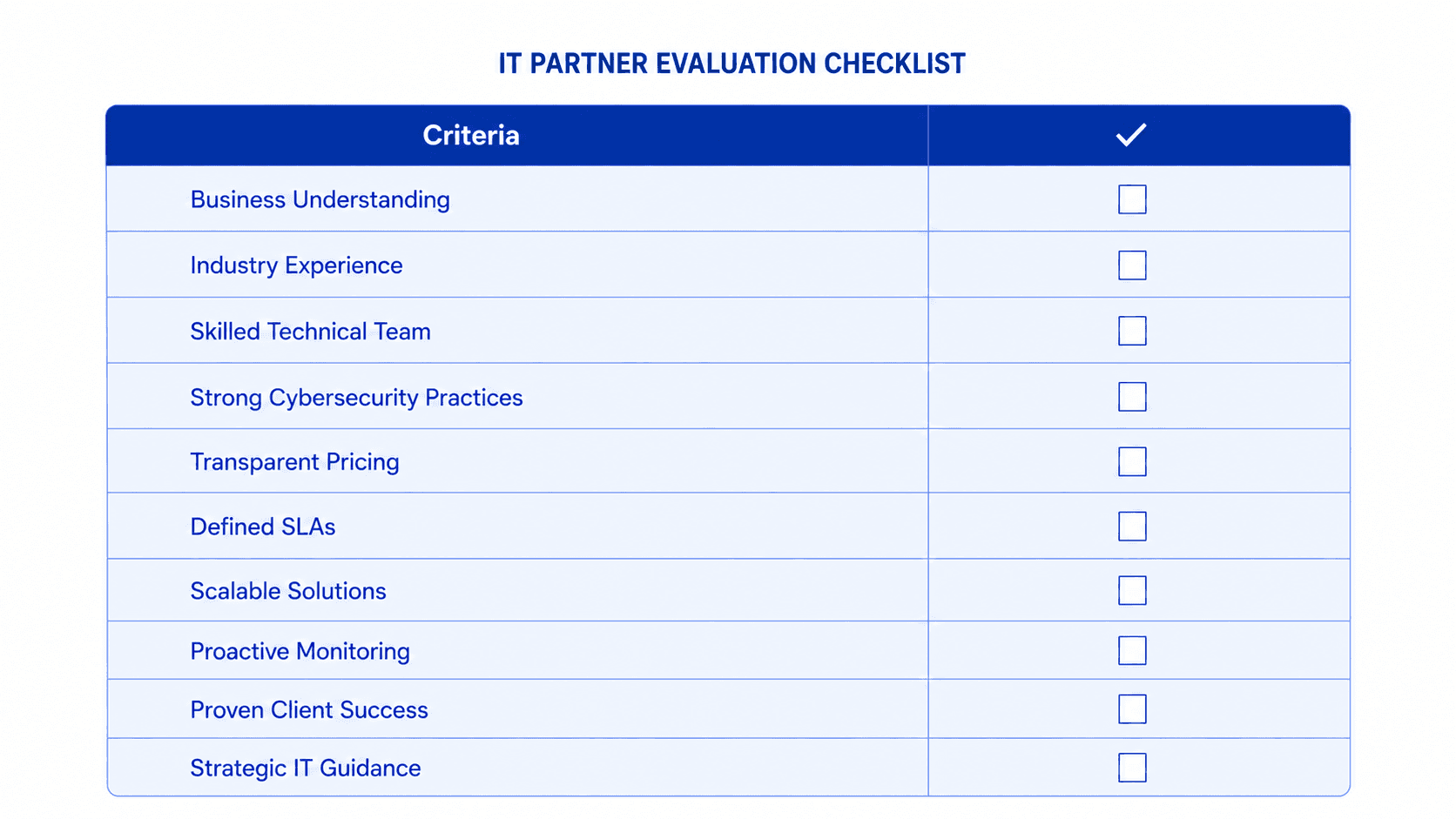
Conclusion
Choosing an IT company in Dubai is about more than finding someone to fix technical problems. Your IT provider can directly influence business continuity, cybersecurity, productivity, infrastructure reliability, and long-term growth.
Before making a decision, evaluate providers based on their UAE market experience, technical capabilities, cybersecurity practices, data protection approach, on-site support, SLA commitments, contract terms, scalability, and ability to support your future technology requirements.
The right IT partner should provide more than reactive support. It should help your business build a secure, resilient, and scalable technology environment that can adapt as your organization grows.
For businesses seeking a trusted technology partner, Instalogic delivers advanced Business Intelligence, ERP systems, bespoke software development, and AI-powered technology solutions tailored to the evolving needs of modern organizations. With a focus on innovation, scalability, and customer-centric service, Instalogic helps businesses streamline operations, unlock data-driven insights, automate processes, and accelerate digital transformation through intelligent, future-ready technology solutions.
